Wednesday, January 21, 2009

Saturday, November 01, 2008
False is true - Illusion of Truth
My former professor Brian Skurnik won a price with his latest paper on the 'Illusion of Truth' effect. Here's the abstract: "Telling people that a consumer claim is false can make them misremember it as true. In two experiments older adults were especially susceptible to this "illusion of truth" effect. Repeatedly identifying a claim as false helped older adults remember it as false in the short term, but paradoxically made them more likely to remember it as true after a three-day delay. This unintended effect of repetition comes from increased familiarity with the claim itself, but decreased recollection of the claim's original context. Findings provide insight into susceptibility over time to memory distortions and exploitation via repetition of claims in media and advertising."
Sunday, October 26, 2008
Tiger Woods: a bad golfer!
Nearly everyone thinks that Tiger Woods is an exceptional golfer. If you look at the statistics you will be surprised to see that Tiger Woods is an absolutely terrible player when you look at his performance in bunkers. It appears like a contradiction to have one of the best golfers in history to practically fail in certain aspects of the sport. How can one resolve this?
When looking at the performance of athletes or business professionals one oftentimes focuses on a dualistic view, i.e. one is good or bad at something. If you are bad at something then it follows that you should improve and become good at it. A lot of resources are put into place to advance and over time eventually one moves towards becoming "good at it". And so it goes.
The real question, however is, if the property is also "important". Maybe it is just "unimportant". What does that mean? In the example with Tiger Woods one can see by looking at the PGA statistics board that the "Tiger" is bad at bunker shots. However, if you add the second dimension of "Important/Unimportant" one can grasp to understand that this is a rather unimportant skills for Tiger. Why? Quite frankly, Tiger Woods can afford to be bad at bunker shots because he doesn't need to be good at bunker shots. Tiger Woods avoids hitting bunkers altogether therefore he doesn't need to waste his time improving his bad score but rather invests his scares resource, i.e. time, in further improving his performance on the green. The following 2x2 matrix illustrates this finding:
When looking at the performance of athletes or business professionals one oftentimes focuses on a dualistic view, i.e. one is good or bad at something. If you are bad at something then it follows that you should improve and become good at it. A lot of resources are put into place to advance and over time eventually one moves towards becoming "good at it". And so it goes.
The real question, however is, if the property is also "important". Maybe it is just "unimportant". What does that mean? In the example with Tiger Woods one can see by looking at the PGA statistics board that the "Tiger" is bad at bunker shots. However, if you add the second dimension of "Important/Unimportant" one can grasp to understand that this is a rather unimportant skills for Tiger. Why? Quite frankly, Tiger Woods can afford to be bad at bunker shots because he doesn't need to be good at bunker shots. Tiger Woods avoids hitting bunkers altogether therefore he doesn't need to waste his time improving his bad score but rather invests his scares resource, i.e. time, in further improving his performance on the green. The following 2x2 matrix illustrates this finding:
 It is obvious to avoid activities on the left side and redirect resources and efforts from points "A" and "B" towards "T". The not so obvious point is "how" to do this. Depending on the type of the "game" played or the business situation you are in, a solution will be different. In a "looser-game" (see details in my other blog postings) one will likely have to improve the position in "B" and move towards point "T". In a "Winner-game" you have the opportunity to abandon points "A" and "B" and concentrate on improving "T". This is what Tiger Woods does! Professional Golf (unlike amateur golf!) is a Winner-Game and the statistics prove that TW is improving on "T" while abondoning the bunker quadrant.
 A corporate citizen is often confronted with a Looser-Game unlike Entrepreneurs that are more likely to be participants in a Winner-Game. This might be the reason why large corporatins accumulate many mediocre players over time while top-performers will be playing in a different game.
Moving parts & lateral brain teaser

A lateral brain teaser is a question that cannot be solved with regular logic. Here is an example:
A sun dial is the time piece with the fewest moving parts. What is the time piece with the most moving parts? Answer: an hour glass is the most common answer. I personally think that Foucault pendulum is a good answer too since the whole apparatus moves. Granted it has less parts than an hour glass.
Saturday, October 25, 2008
First mover advantage
You and I play a game where we take turns rolling a die. I win if I roll a 4. You win if you roll a 5. If I go first, what’s the probability that I win? There are several answer options but I find the one below most intuitive:
This dice problem is mentally tricky because many rounds end without a winner. It would seem necessary to keep track of an infinite series to arrive at an answer. But that’s not the case. The trick is seeing that each round is really an independent sub-game. The fact that the previous round ended without a winner does not affect the winner of the current round or any future round. This means we can safely ignore outcomes without winners.
The probability of winning depends only on the features of a single round. This simplifies the problem to a more tractable one. So now, assume that one of the players did win in a round, and then calculate the relative winning percentages. In other words, calculate the probability the first player wins given the round definitely produced a winner. To do that, we look at the distribution of outcomes. In any given round, the first player can roll six outcomes, as can the second player. How many of those thirty-six outcomes produce a winner, and how many are from the first player?
This diagram illustrates the answer:

There are exactly 11 outcomes where somebody wins, of which 6 belong to the first player. Therefore, the first player wins with a 6/11 chance, or about 54.5 percent of the time. This is the same numerical answer as Monte Carlo, but we get an explanation why it works. The first-mover advantage is caused by the fact the first player wins even if both were to roll winning numbers.
Source: http://mindyourdecisions.com
This dice problem is mentally tricky because many rounds end without a winner. It would seem necessary to keep track of an infinite series to arrive at an answer. But that’s not the case. The trick is seeing that each round is really an independent sub-game. The fact that the previous round ended without a winner does not affect the winner of the current round or any future round. This means we can safely ignore outcomes without winners.
The probability of winning depends only on the features of a single round. This simplifies the problem to a more tractable one. So now, assume that one of the players did win in a round, and then calculate the relative winning percentages. In other words, calculate the probability the first player wins given the round definitely produced a winner. To do that, we look at the distribution of outcomes. In any given round, the first player can roll six outcomes, as can the second player. How many of those thirty-six outcomes produce a winner, and how many are from the first player?
This diagram illustrates the answer:
There are exactly 11 outcomes where somebody wins, of which 6 belong to the first player. Therefore, the first player wins with a 6/11 chance, or about 54.5 percent of the time. This is the same numerical answer as Monte Carlo, but we get an explanation why it works. The first-mover advantage is caused by the fact the first player wins even if both were to roll winning numbers.
Source: http://mindyourdecisions.com
Friday, September 26, 2008
Andreas Hagenkamp & Tobi

Family friend Andreas Hagenkamp came over to visit Google during his stay in Silicon Valley.
Wednesday, September 24, 2008
The successful entrepreneur
All it takes to start a company is about 50 bucks and a visit at the local Office Depot to pick-up some generic incorporation forms. The challenging part is to create a successful (!) company. I'm jotting down a few components that haven statistically proven to stir up a much more successful company. In fact everything you are reading has been borrowed from my former professor Greg Fairchild at Darden who has studied the significance of certain aspects.
1. "Three or more": To be successful in the long-run one should have at least three founders in the company. Sure, you always want to have an uneven number of key people to avoid voting conflicts. More importantly you think about the business differently with three or more people. If you have only two persons you will talk back and forth and hear what you already know. This helps little to advance the company in the early days. With three members you will start a dynamic that can evolve into something new and better.
2. "Sales Guy": Do have an experienced sales person on your team. Why? Well, the greatest idea is worth nothing if you can't sell it. A sales person will know what it takes to sell and pitch an idea early on. He/She will help you steer into a direction that yields cash sooner than later. Please note that you should have an experienced sales person - not a person who wants to be experienced.
3. "Serial entrepreneurs": This sounds like a contradiction but the key to success is to fail and keep trying. I'm leaving out the percentages, that I don't have with me, but your chance of ending up in a profitable business is increasing dramatically with each business in which you have failed. What does that mean? First and foremost: don't give up once you fail. Second, have realistic expectations that the next or first start-up might not be it. It would be nice but it's more likely that you will succeed in the long-run. Again, don't give up.
One little chip of information at the end. So which business yields the most millionaires? Believe it or not, and without immediate backup, I remember from my MBA class that the "Dry-Cleaning-Business" brings out the most millionaires. A surprise? :-)
1. "Three or more": To be successful in the long-run one should have at least three founders in the company. Sure, you always want to have an uneven number of key people to avoid voting conflicts. More importantly you think about the business differently with three or more people. If you have only two persons you will talk back and forth and hear what you already know. This helps little to advance the company in the early days. With three members you will start a dynamic that can evolve into something new and better.
2. "Sales Guy": Do have an experienced sales person on your team. Why? Well, the greatest idea is worth nothing if you can't sell it. A sales person will know what it takes to sell and pitch an idea early on. He/She will help you steer into a direction that yields cash sooner than later. Please note that you should have an experienced sales person - not a person who wants to be experienced.
3. "Serial entrepreneurs": This sounds like a contradiction but the key to success is to fail and keep trying. I'm leaving out the percentages, that I don't have with me, but your chance of ending up in a profitable business is increasing dramatically with each business in which you have failed. What does that mean? First and foremost: don't give up once you fail. Second, have realistic expectations that the next or first start-up might not be it. It would be nice but it's more likely that you will succeed in the long-run. Again, don't give up.
One little chip of information at the end. So which business yields the most millionaires? Believe it or not, and without immediate backup, I remember from my MBA class that the "Dry-Cleaning-Business" brings out the most millionaires. A surprise? :-)
Sunday, August 24, 2008
OODA Loop
Example of a typical Air Combat Manoeuvre, in this case the "Lufberry":

The OODA Loop is a favorite concept of mine that comes out of the military strategy field. It was first developed by war fighters and stands for "Observe Orient Decide Act". I particularly enjoy that the dimension of "speed" plays an important role in the OODA Loop.
Wikipedia states: "How does one interfere with an opponent's OODA cycle? One of John Boyd's primary insights in fighter combat was that it is vital to change speed and direction faster than the opponent. This is not necessarily a function of the plane's ability to maneuver, rather the pilot must think and act faster than the opponent can think and act. Getting "inside" the cycle — short-circuiting the opponent's thinking processes - produces opportunities for the opponent to react inappropriately.
Another tactical-level example can be found on the basketball court, where a player takes possession of the ball and must get past an opponent who is taller or faster. A straight dribble or pass is unlikely to succeed. Instead the player may engage in a rapid and elaborate series of body movements designed to befuddle the opponent and deny him the ability to take advantage of his superior size or speed. At a basic level of play, this may be merely a series of fakes, with the hope that the opponent will make a mistake or an opening will occur. But practice and mental focus may allow one to reduce the time scale, get inside the opponent's OODA loop, and take control of the situation - to cause the opponent to move in a particular way, and generate an advantage rather than merely reacting to an accident."
Thursday, July 24, 2008
Saturday, July 19, 2008

Sunday, July 13, 2008
Authors@Google: Dan Ariely
I missed Dan Ariely but thankfully his presentation at Google was recorded on YouTube.
Sunday, July 06, 2008
Why Free! is great

Have you ever grabbed for a coupon offering a free! package of coffee beans—even though you don’t drink coffee and don’t even have a machine with which to brew it? What about all those free! extra helpings you piled on your plate at a buffet, even though your stomach had already started to ache from all the food you had consumed? And what about the worthless free! stuff you’ve accumulated—the promotional T-shirt from the radio station, the teddy bear that came with the box of Valentine chocolates, the magnetic calendar your insurance agent sends you each year?
It’s no secret that getting something free feels very good. Zero is not just another price, it turns out. Zero is an emotional hot button—a source of irrational excitement. Would you buy something if it were discounted from 50 cents to 20 cents? Maybe. Would you buy it if it were discounted from 50 cents to two cents? Maybe. Would you grab it if it were discounted from 50 cents to zero? You bet!
What is it about zero cost that we find so irresistible? Why does free! make us so happy? After all, free! can lead us into trouble: things that we would never consider purchasing become incredibly appealing as soon as they are free! For instance, have you ever gathered up free pencils, key chains, and note pads at a conference, even though you’d have to carry them home and would only throw most of them away? Have you ever stood in line for a very long time (too long), just to get a free cone of Ben and Jerry’s ice cream? Or have you bought two of a product that you wouldn’t have chosen in the first place, just to get the third one for free?
What is it about free! that’s so enticing? Why do we have an irrational urge to jump for a free! item, even when it’s not what we really want?
I believe the answer is this. Most transactions have an upside and a downside, but when something is free! we forget the downside. Free! gives us such an emotional charge
that we perceive what is being offered as immensely more valuable than it really is. Why? I think it’s because humans are intrinsically afraid of loss. The real allure of free! is tied to this fear. There’s no visible possibility of loss when we choose a free! item (it’s free). But suppose we choose the item that’s not free. Uh- oh, now there’s a risk of having made a poor decision—the possibility of a loss. And so, given the choice, we go for what is free.
Source: Daniel Ariery, http://g-ecx.images-amazon.com/images/G/01/books/a-plus/Predictably-Irrational-Excerpt.pdf
Online Dating & Disappointments
Daniel Ariely is closing the gap on why we are more disappointed the more we know about a person.
Friday, July 04, 2008
Sunday, June 22, 2008

Saturday, June 14, 2008
Fishing, Competition and Strategy
Sport fishing is one of my interests and one can wait a long time for some action while doing it. Eventually I had so much time that I started thinking about fishing in a broader context and wondered if you can draw anything away for it on a strategic level: fishing and strategy!
Like in many business situation you compete also while fishing. Most obviously you and the fish compete about who keeps the 'worm' (Note that even the worm competes for a resource, unless it's plastic, to stay away from the angler and any fish). Certainly you compete with other fishermen and nothing is probably more exciting and less close to reality than answering another fellow fisherman's question of "any bites" ? Don't forget that you are also competing with other creatures (fish, turtles and birds) who enjoy fish like you and the other anglers do.
Last but not least you compete with yourself. Once you become more successful and fished nearly every fish out there it becomes increasingly more difficult to stay successful. One might even argue that the smartest fish is the most experienced and oldest fish who is a) biggest and b) probably in the pond until the very end. How do you get him?
Let's look at means of fishing. A fishing rod helps but there are other things. Be a little bit more creative when it comes to means! Of course you can use a net with a varying 'threat-count'. What do you want to catch? A net seems like an easy way to catch any fish that is larger than the openings in your net but it's also very costly. A net is nothing else than a capital investment and it will take a long time to be successful and recoup the investment. A faster and much cheaper idea is to use dynamite. Boom and that's it. Note that this practice is usually not legal, it's more dangerous and you have no control over the result unless you like to eat fish-pieces only. This very effective method is neither sustainable nor will you earn the respect of your competition. You are running into trouble in the long-run also because everything in the pond has been wiped out and you will have to find another lake to fish in the future. Your idea with the net seemed not too bad after all and you might want to consider to put a much smaller net upstream on a connecting river. Larger fish will travel up the stream through your net - if they could. Your investment is much smaller, it's targeted and you will see results sooner exactly where you expect it. Draining the lake is another way to catch a fish. It might not be totally destructive and make it easier for you to find fish. One more option comes to mind. If you life in certain areas and like to focus on catfish you might decide to forget about a rod and net altogether. Catfish noodling is very popular and you basically use your hand to fish for catfish 1x1.
So don't limit yourself to just one method of fishing, i.e. the rod method and think creatively about what might be an appropriate fishing method. Effectiveness might not always be the way to go.
Of course you have to do your 'hygiene', i.e. your homework before you start fishing. Prepare yourself and find out everything you can about the area, the lake (depth, temperature, etc.) the containing fish and best time of fishing. This will not guarantee that you will catch anything but increase the likelihood of winning. You might be better of to experiment at the lake. Can you change a) your position, b) bait, c) means of fishing and d) time of fishing? If you are more successful at dawn there's probably a reason for it so keep fishing at dawn if it works out. A little espionage - only if it's legal! - can help too. Are there other people, what's on their hook and in their buckets?
Your positioning might help or hurt you. If you are close to your competitors (i.e. the other fishermen) you will compete for the same fish that is coming by and might end-up fighting. You can hide on the other side of the lake and stay 'under the radar'. You are also staying out of trouble. Avoid confrontations if you can: it's not giving you any more fish! In fact, fish don't like noise so it WILL hurt both of you. If you have more money try to buy a boat. This will put you on a different spot (on the middle of the lake!) where there might be bigger fish in the depth. Remember that the big fish is big for a reason: probably it stayed away from the edge of the lake for a long time and is safe in the middle in the depth.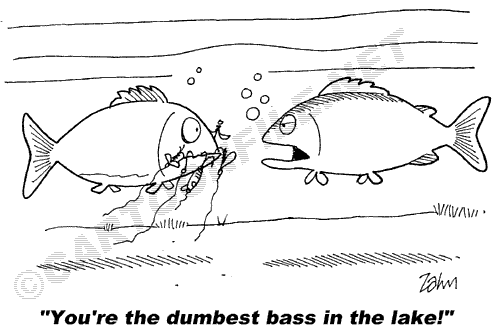 That's your chance especially since there are not many other people usually fishing here. If you are smart you will not buy a boat but rather rent or even better loan one.
Technology, another small investment, can be your friend. With a fish-finder you can 'see' the fish even if YOU can't see it. You can safe a lot of muda (japanese for 'waste') in terms of time, effort and bait if you know where the fish a) is and where it b) is not.
Finally experience will help you a LOT! Experience means you see things that other people don't see. You will know that those little bubbles and waves on the top are from fish which will show you their location. Your experience will also tell you not too fish for trout in small lakes with a lot of sunlight as trout likes cold water. So don't fish for trout but for bass who likes warm water!
You will find more analogies if you leave your business situation and compare it to other areas in life. Of course you will also find many situations where the comparisons breaks-down and that's where it's getting interesting. Why can't you compare this situation with another one and what can you take-away from this insight?
P.s.: Eventually you find that fishing is a very competitive situation and it would be nice to get to the fish without all the 'hassle'. Especially if you are in an area where are no lakes at all you might run into a problem or challenge. Is there anything you can do except than giving up i.e. leaving the market? Often there is and you should use it to your advantage. Fish-farming is a huge business e.g. in Israel and it turns out that you can achieve magnificent yields in what one would think unproductive areas.
Like in many business situation you compete also while fishing. Most obviously you and the fish compete about who keeps the 'worm' (Note that even the worm competes for a resource, unless it's plastic, to stay away from the angler and any fish). Certainly you compete with other fishermen and nothing is probably more exciting and less close to reality than answering another fellow fisherman's question of "any bites" ? Don't forget that you are also competing with other creatures (fish, turtles and birds) who enjoy fish like you and the other anglers do.
Last but not least you compete with yourself. Once you become more successful and fished nearly every fish out there it becomes increasingly more difficult to stay successful. One might even argue that the smartest fish is the most experienced and oldest fish who is a) biggest and b) probably in the pond until the very end. How do you get him?
Let's look at means of fishing. A fishing rod helps but there are other things. Be a little bit more creative when it comes to means! Of course you can use a net with a varying 'threat-count'. What do you want to catch? A net seems like an easy way to catch any fish that is larger than the openings in your net but it's also very costly. A net is nothing else than a capital investment and it will take a long time to be successful and recoup the investment. A faster and much cheaper idea is to use dynamite. Boom and that's it. Note that this practice is usually not legal, it's more dangerous and you have no control over the result unless you like to eat fish-pieces only. This very effective method is neither sustainable nor will you earn the respect of your competition. You are running into trouble in the long-run also because everything in the pond has been wiped out and you will have to find another lake to fish in the future. Your idea with the net seemed not too bad after all and you might want to consider to put a much smaller net upstream on a connecting river. Larger fish will travel up the stream through your net - if they could. Your investment is much smaller, it's targeted and you will see results sooner exactly where you expect it. Draining the lake is another way to catch a fish. It might not be totally destructive and make it easier for you to find fish. One more option comes to mind. If you life in certain areas and like to focus on catfish you might decide to forget about a rod and net altogether. Catfish noodling is very popular and you basically use your hand to fish for catfish 1x1.
So don't limit yourself to just one method of fishing, i.e. the rod method and think creatively about what might be an appropriate fishing method. Effectiveness might not always be the way to go.
Of course you have to do your 'hygiene', i.e. your homework before you start fishing. Prepare yourself and find out everything you can about the area, the lake (depth, temperature, etc.) the containing fish and best time of fishing. This will not guarantee that you will catch anything but increase the likelihood of winning. You might be better of to experiment at the lake. Can you change a) your position, b) bait, c) means of fishing and d) time of fishing? If you are more successful at dawn there's probably a reason for it so keep fishing at dawn if it works out. A little espionage - only if it's legal! - can help too. Are there other people, what's on their hook and in their buckets?
Your positioning might help or hurt you. If you are close to your competitors (i.e. the other fishermen) you will compete for the same fish that is coming by and might end-up fighting. You can hide on the other side of the lake and stay 'under the radar'. You are also staying out of trouble. Avoid confrontations if you can: it's not giving you any more fish! In fact, fish don't like noise so it WILL hurt both of you. If you have more money try to buy a boat. This will put you on a different spot (on the middle of the lake!) where there might be bigger fish in the depth. Remember that the big fish is big for a reason: probably it stayed away from the edge of the lake for a long time and is safe in the middle in the depth.
That's your chance especially since there are not many other people usually fishing here. If you are smart you will not buy a boat but rather rent or even better loan one.Technology, another small investment, can be your friend. With a fish-finder you can 'see' the fish even if YOU can't see it. You can safe a lot of muda (japanese for 'waste') in terms of time, effort and bait if you know where the fish a) is and where it b) is not.
Finally experience will help you a LOT! Experience means you see things that other people don't see. You will know that those little bubbles and waves on the top are from fish which will show you their location. Your experience will also tell you not too fish for trout in small lakes with a lot of sunlight as trout likes cold water. So don't fish for trout but for bass who likes warm water!
You will find more analogies if you leave your business situation and compare it to other areas in life. Of course you will also find many situations where the comparisons breaks-down and that's where it's getting interesting. Why can't you compare this situation with another one and what can you take-away from this insight?
P.s.: Eventually you find that fishing is a very competitive situation and it would be nice to get to the fish without all the 'hassle'. Especially if you are in an area where are no lakes at all you might run into a problem or challenge. Is there anything you can do except than giving up i.e. leaving the market? Often there is and you should use it to your advantage. Fish-farming is a huge business e.g. in Israel and it turns out that you can achieve magnificent yields in what one would think unproductive areas.
Monday, May 26, 2008
Loser's versus Winner's game
Simon Ramo identified the crucial difference between a Winner's Game and a Loser's Game in his excellent book on playing strategy, Extraordinary Tennis for the Ordinary Tennis Player. Over a period of many years, he observed that tennis was not one game but two. One game of tennis is played by professionals and a very few gifted amateurs; the other is played by all the rest of us.
Although players in both games use the same equipment, dress, rules and scoring, and conform to the same etiquette and customs, the basic natures of their two games are almost entirely different. After extensive scientific and statistical analysis, Dr. Ramo summed it up this way: Professionals win points; amateurs lose points. Professional tennis players stroke the ball with strong, well aimed shots, through long and often exciting rallies, until one player is able to drive the ball just beyond the reach of his opponent. Errors are seldom made by these splendid players. Expert tennis is what I call a Winner's Game. Amateur tennis, Ramo found, is almost entirely different. Brilliant shots, long and exciting rallies, and seemingly miraculous recoveries are few and far between. On the other hand, the ball is fairly often hit into the net or out of bounds, and double faults at service are not uncommon. The amateur duffer seldom beats his opponent, but he beats himself all the time. The victor in this game of tennis gets a higher score than the Opponent, but he gets that higher score because his opponent is losing even more points.
As a scientist and statistician, Dr. Ramo gathered data to test his hypothesis. And he did it in a very clever way. Instead of keeping conventional game scores---"Love," "Fifteen All," "Thirty-Fifteen," etc.-~amo simply counted points won versus points lost. And here is what he found. In expert tennis, about 80 percent of the points are won; in amateur tennis, about 80 percent of the points are lost. In other words, professional tennis is a Winner's Game--the final outcome is determined by the activities of the winner--and amateur tennis is a Loser's Game---the final outcome is determine d by the activities of the loser. The two games are, in their fundamental characteristic, not at all the same. They are opposites.
From this discovery of the two kinds of tennis, Dr. Ramo builds a complete strategy by which ordinary tennis players can win games, sets and matches again and again by following the simple strategy of losing less, and letting the opponent defeat himself.
Dr. Ramo explains that if you choose to win at tennis--as opposed to having a good time--the strategy for winning is to avoid mistakes. The way to avoid mistakes is to be conservative and keep the ball in play, letting the other fellow have plenty of room in which to blunder his way to defeat, because he, being an amateur (and probably not having read Ramo's book) will play a losing game and not know it.
Although players in both games use the same equipment, dress, rules and scoring, and conform to the same etiquette and customs, the basic natures of their two games are almost entirely different. After extensive scientific and statistical analysis, Dr. Ramo summed it up this way: Professionals win points; amateurs lose points. Professional tennis players stroke the ball with strong, well aimed shots, through long and often exciting rallies, until one player is able to drive the ball just beyond the reach of his opponent. Errors are seldom made by these splendid players. Expert tennis is what I call a Winner's Game. Amateur tennis, Ramo found, is almost entirely different. Brilliant shots, long and exciting rallies, and seemingly miraculous recoveries are few and far between. On the other hand, the ball is fairly often hit into the net or out of bounds, and double faults at service are not uncommon. The amateur duffer seldom beats his opponent, but he beats himself all the time. The victor in this game of tennis gets a higher score than the Opponent, but he gets that higher score because his opponent is losing even more points.
As a scientist and statistician, Dr. Ramo gathered data to test his hypothesis. And he did it in a very clever way. Instead of keeping conventional game scores---"Love," "Fifteen All," "Thirty-Fifteen," etc.-~amo simply counted points won versus points lost. And here is what he found. In expert tennis, about 80 percent of the points are won; in amateur tennis, about 80 percent of the points are lost. In other words, professional tennis is a Winner's Game--the final outcome is determined by the activities of the winner--and amateur tennis is a Loser's Game---the final outcome is determine d by the activities of the loser. The two games are, in their fundamental characteristic, not at all the same. They are opposites.
From this discovery of the two kinds of tennis, Dr. Ramo builds a complete strategy by which ordinary tennis players can win games, sets and matches again and again by following the simple strategy of losing less, and letting the opponent defeat himself.
Dr. Ramo explains that if you choose to win at tennis--as opposed to having a good time--the strategy for winning is to avoid mistakes. The way to avoid mistakes is to be conservative and keep the ball in play, letting the other fellow have plenty of room in which to blunder his way to defeat, because he, being an amateur (and probably not having read Ramo's book) will play a losing game and not know it.
Rule of the game (example tennis)
When we watch a sporting event like a tennis tournament we might hope for a favorite player to win and even feel upset if he loses. However, we don’t often question the rules of the tournament. Lewis Carroll, better known as the author of Alice in Wonderland, explains why the typical tournament structure often fails to award best players the top prizes and offers an alternative method.
In an elimination tournament, each player can only advance along a certain path toward the final. As each player moves through this space, the field is narrowed, until the top prizes are determined. The structure of the space critically influences who finishes well in the tournament. A competition that seems at first glance to be fairly structured to filter out the weaker players may, in fact, not be good at all at selecting the best competitors. In any competition it is not just skill and lucky breaks that determine the winners; the rules of the competition itself determine who will finish well. Many competitions are structured to correctly determine only first place; the second and third prizes are very much subject to chance.
Let us take, as an example of the present method, a Tournament of 32 competitors with 4 prizes.
On the 1st day, these contend in 16 pairs: on the 2nd day, the 16 Winners contend in 8 pairs, the Losers being excluded from further competition: on the 3rd day, the 8 Winners contend in 4 pairs: on the 4th day, the 4 Winners (who are now known to be the 4 Prize-Men) contend in 2 pairs; and on the 5th day, the 2 Winners contend together to decide which is to take the 1st prize and which the 2nd -- the two Losers having no further contest, as the 3rd and 4th prizes are of equal value.
Now, if we divide the list of competitors, arranged in the order in which they are paired, into 4 sections, we may see that all that this method really does is to ascertain who is best in each section, then who is best in each half of the list, and then who is best of all. The best of all (and this is the only equitable result arrived at) wins the 1st prize: the best in the other half of the list wins the 2nd: and the best men in the two sections not yet represented by a champion win the other two prizes. If the Players had chanced to be paired in the order of merit, the 17th best Player would necessarily carry off the 2nd prize, and the 9th and 25th best the 3rd and 4th! This of course is an extreme case: but anything within these limits is possible: e.g. any competitor, from the 3rd best to the 17th best, may, by the mere accidental arrangement of pairs, and by no means as a result of his own skill, carry off the 2nd prize. As a mathematical fact, the chance that the 2nd best Player will get the prize he deserves is only 16/31sts; while the chance that the best 4 shall get their proper prizes is so small, that the odds are 12 to 1 against its happening!
Therefore don't assume that the rules of the game favor the best. The rules of the games are oftentimes predetermined and one can either influence those or even change the entry point into the competition.
Source: BCG, Strategy institute
In an elimination tournament, each player can only advance along a certain path toward the final. As each player moves through this space, the field is narrowed, until the top prizes are determined. The structure of the space critically influences who finishes well in the tournament. A competition that seems at first glance to be fairly structured to filter out the weaker players may, in fact, not be good at all at selecting the best competitors. In any competition it is not just skill and lucky breaks that determine the winners; the rules of the competition itself determine who will finish well. Many competitions are structured to correctly determine only first place; the second and third prizes are very much subject to chance.
Let us take, as an example of the present method, a Tournament of 32 competitors with 4 prizes.
On the 1st day, these contend in 16 pairs: on the 2nd day, the 16 Winners contend in 8 pairs, the Losers being excluded from further competition: on the 3rd day, the 8 Winners contend in 4 pairs: on the 4th day, the 4 Winners (who are now known to be the 4 Prize-Men) contend in 2 pairs; and on the 5th day, the 2 Winners contend together to decide which is to take the 1st prize and which the 2nd -- the two Losers having no further contest, as the 3rd and 4th prizes are of equal value.
Now, if we divide the list of competitors, arranged in the order in which they are paired, into 4 sections, we may see that all that this method really does is to ascertain who is best in each section, then who is best in each half of the list, and then who is best of all. The best of all (and this is the only equitable result arrived at) wins the 1st prize: the best in the other half of the list wins the 2nd: and the best men in the two sections not yet represented by a champion win the other two prizes. If the Players had chanced to be paired in the order of merit, the 17th best Player would necessarily carry off the 2nd prize, and the 9th and 25th best the 3rd and 4th! This of course is an extreme case: but anything within these limits is possible: e.g. any competitor, from the 3rd best to the 17th best, may, by the mere accidental arrangement of pairs, and by no means as a result of his own skill, carry off the 2nd prize. As a mathematical fact, the chance that the 2nd best Player will get the prize he deserves is only 16/31sts; while the chance that the best 4 shall get their proper prizes is so small, that the odds are 12 to 1 against its happening!
Therefore don't assume that the rules of the game favor the best. The rules of the games are oftentimes predetermined and one can either influence those or even change the entry point into the competition.
Source: BCG, Strategy institute
Sunday, May 25, 2008
Fishing and startegy
The pike is one of the most efficient, lean predating machines in freshwater. If you put a small pike in an aquarium with a bunch of minnows it will demonstrate its predatory skills with frightening efficiency. If you separate the pike from the minnows using a sheet of perspex the pike will continue to launch its attacks for a little while. And then it will just give up. You can then remove the sheet of perspex and the pike will still believe that it can no longer catch its prey - and will simply starve to death.
This little tale is similar to the "Learned helplessness" theory which can also be found in my blog and is posted at an earlier date.
This little tale is similar to the "Learned helplessness" theory which can also be found in my blog and is posted at an earlier date.
Subscribe to:
Posts (Atom)